Disclaimer: The information on this website is provided for educational purposes only. It is not intended as medical advice and should not be used as a substitute for individualized medical care. Always consult your physician or other qualified healthcare professional regarding any questions about your health, diet, or medical conditions.
How to Increase GLP-1 Without Drugs
Diet and Lifestyle Changes that Promote Satiety and Less Hunger
by Charles O. Frazier, MD, FAAFP
January 2026
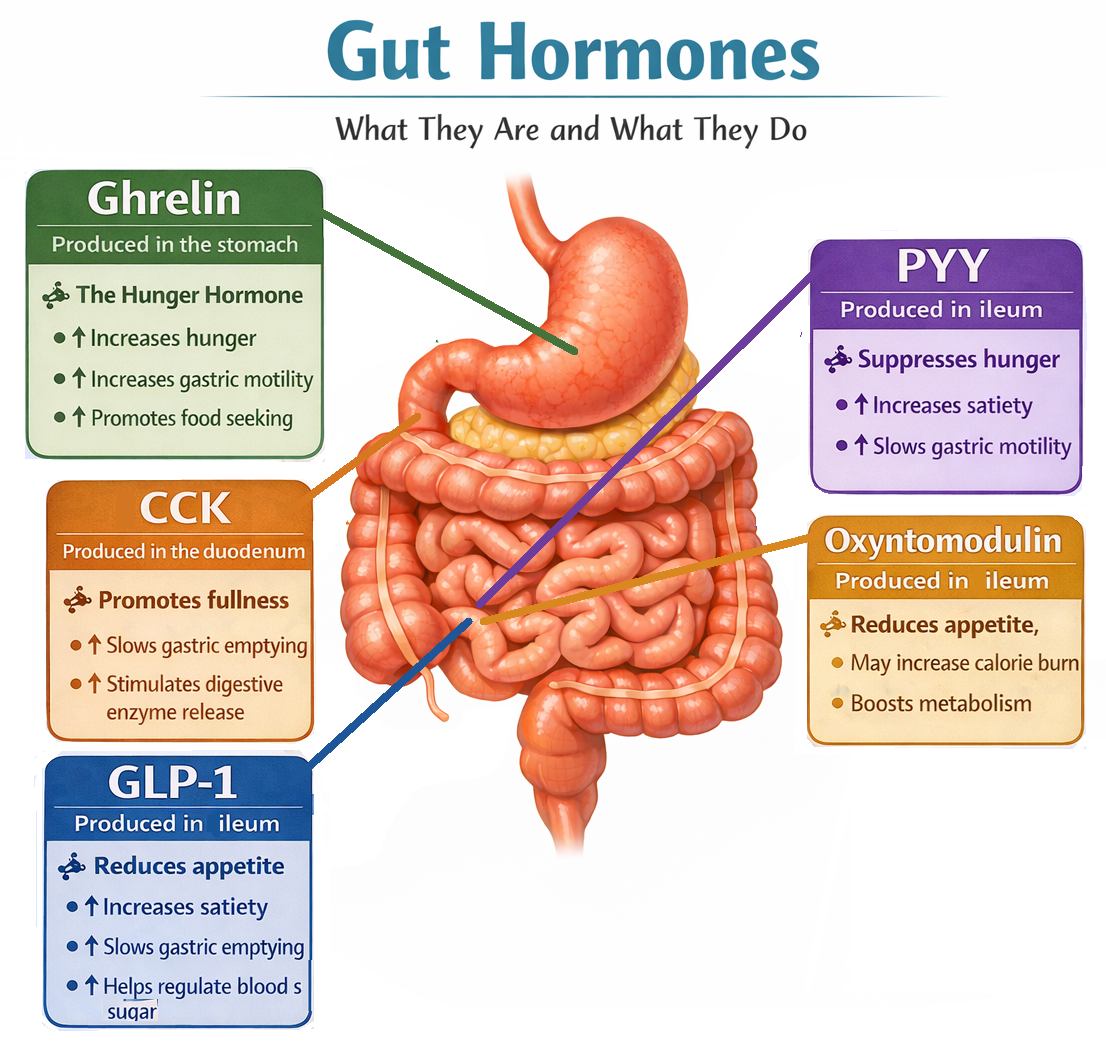
Okay, I admit it -- I put GLP-1 in the title just to catch your attention. There is a LOT of hype and interest about GLP-1 agonists (injections and now pills), but while I will discuss GLP-1, I will also talk about several other hormones that are made in our intestines that influence appetite and satiety (feeling of fullness). Those hormones are GLP-1 (glucagon-like peptide-1), PYY (peptide YY), CCK (cholecystokinin), oxyntomodulin, and ghrelin. Here is a chart that summarizes what these hormones do from a satiety/appetite standpoint.
GLP-1
GLP-1 (glucagon-like peptide-1) is a hormone made in the last
part of the small intestine that reduces appetite and makes you feel
full. It also slows gastric emptying and plays a role in blood sugar
metabolism. Under normal circumstances, as digesting food starts to
enter the ileum, GLP-1 is produced and is released into the blood
stream. It slows the rate at which the stomach empties, increases
the sensation of fullness, and also affects the brain to reduce
appetite. The diabetes and weight-loss medications you have heard
abou -- GLP-1 agonists (an agonist is a molecule that attaches to a
receptor in the body and produces the same effect as a natural
molecule) -- mimic these effects, leading to lower blood sugar,
reduced appetite, and weight loss.
PYY
PYY, or
peptide YY, is also made in the last part of the small intestine
(the ileum). It slows stomach motility and increases the sense of
fullness.
CCK
CCK, or cholecystokinin, is a hormone made in the first part of the small intestine, the duodenum. Its main job is to stimulate the gall bladder to squirt out bile. But it also has effects on the stomach and the release of digestive enzymes. It helps satiety, but also aids digestion.
Oxyntomodulin
Oxyntomodulin is another hormone made in the ileum. It reduces
appetite, but also may increase metabolism and the burning of
calories.
Ghrelin
Ghrelin is made in the stomach. It is
the "hunger hormone". The stomach makes more of it as it become
emptier, and ghrelin also stimulates our appetite.
So what foods, beverages, or behaviors INCREASE GLP-1 and/or PYY
and/or CCK and/or oxyntomodulin? And what DECREASES ghrelin?
Protein
There
is evidence that protein intake increases GLP-1, PYY and CCK, while
decreasing ghrelin (Belza 2013) at the same time. Another study
showed that a high protein breakfast significantly increases GLP-1
and PYY (van der Klaauw 2013), while a meta-analysis (a statistical
approach that combines several similar studies, in this case nearly
70 studies) high protein ingestion significantly increased GLP-1 and
CCK (but, interestingly, not PYY as much), while also significantly
decreasing ghrelin (Kohanmoo 2020).
Soluble Fiber
Dietary fiber has several effects that can facilitate loss of
weight. For example, intake of fiber slows gastric emptying
(Anderson 2008; Bortolotti 2008), although that effect seems to
depend on the type of fiber (Tadesse 1986; di Lorenzo 1988). That
delay can cause a feeling of fullness and satiety (Haber 1977; di
Lorenzo 1988), but in addition to the stomach effects, satiety may
also be due to changes in gut hormones (Sanchez 2012). For example,
dietary fiber may lead to less production of the peptide ghrelin,
which stimulates appetite (da Silva 2020). It may increase the other
hormones (GLP-1, PYY, and CCK), but the evidence is substantially
mixed in that regard.
Foods with fiber include fresh fruits
and beans, and to the extent that you get your fiber from the food
you're eating, those are the foods I recommend, rather than eating
peas and grains, which tend to have more starch in proportion to
their fiber content. This is one place where I recommend
supplementation, and my favorite fiber supplements are psyllium and
inulin, which comes from chicory root. These come in powders,
capsules, and gummy bears.
Green Tea
I put
this here only because some animal studies have suggested that the
catechins in green tea may increase GLP-1. But I could not find any
good evidence that increased green tea consumption or the
consumption of green tea extract significantly changes these gut
hormones in a favorable way. Having said that, there is good
evidence that green tea aids weight loss, but it requires about 3-4
cups per day (Sirotkin 2021).
Exercise
Regular exercise has been shown to increase levels of PYY and GLP-1 and decrease ghrelin levels (Smarkusz-Zarzecka).
So, if you are interested in GLP-1 agonist medication, then talk to your doctor about it. But if you would like to affect GLP-1, CCK, PYY, and ghrelin levels naturally, consider making some of the changes above.
References
Belza A, Ritz C, Sorensen MQ, Holst JJ, Rehfeld JF, Astrup A.
Contribution of gastroenteropancreatic appetite hormones to
protein-induced satiety. Am J Clin Nutr. 2013 May;97(5):980-9.
van der Klaauw AA, Keogh JM, Henning E, Trowse VM, Dhillo WS,
Ghatei MA, Farooqi IS. High protein intake stimulates postprandial
GLP1 and PYY release. Obesity (Silver Spring). 2013
Aug;21(8):1602-7.
Kohanmoo A, Faghih S, Akhlaghi M. Effect of short- and long-term
protein consumption on appetite and appetite-regulating
gastrointestinal hormones, a systematic review and meta-analysis of
randomized controlled trials. Physiol Behav. 2020 Nov 1;226:113123.
Anderson JW. Dietary fiber and associated phytochemicals in
prevention and reversal of diabetes. In: Paupuleti VK, Anderson JW,
eds. Nutraceuticals, Glycemic Health and Type 2 Diabetes. Ames,
Iowa: Blackwell Publishing Professional; 2008:111-142.
Bortolotti M, Levorato M, Lugli A, Giosue M. (2008)
Effect of a Balanced Mixture of Dietary Fibers on Gastric Emptying,
Intestinal Transit and Body Weight. Ann Nutr Metab. 2008;
52:221-226.
Tadesse K. (1986) The effect of dietary fibre isolates on gastric
secretion, acidity and emptying. British Journal of Nutrition. 1986;
55:507-513.
Di Lorenzo C, Williams CM, Hajnal F, Valenzuela JE. Pectin
delays gastric emptying and increases satiety in obese subjects.
Gastroenterology. 1988 Nov;95(5):1211-5.
da Silva Borges D, Fernandes R, Thives Mello A, da Silva Fontoura E,
Soares Dos Santos AR, Santos de Moraes Trindade EB. Prebiotics may
reduce serum concentrations of C-reactive protein and ghrelin in
overweight and obese adults: a systematic review and meta-analysis.
Nutr Rev. 2020 Mar 1;78(3):235-248.
Sirotkin AV, Kolesarova A. The anti-obesity and
health-promoting effects of tea and coffee. Physiol Res. 2021 Apr
30;70(2):161-168.
Smarkusz-Zarzecka J, Ostrowska L, Radziszewska M. The Impact of
Environmental Factors on the Secretion of Gastrointestinal Hormones.
Nutrients. 2025 Aug 2;17(15):2544.